Our experience from knowledge-based organizations is:
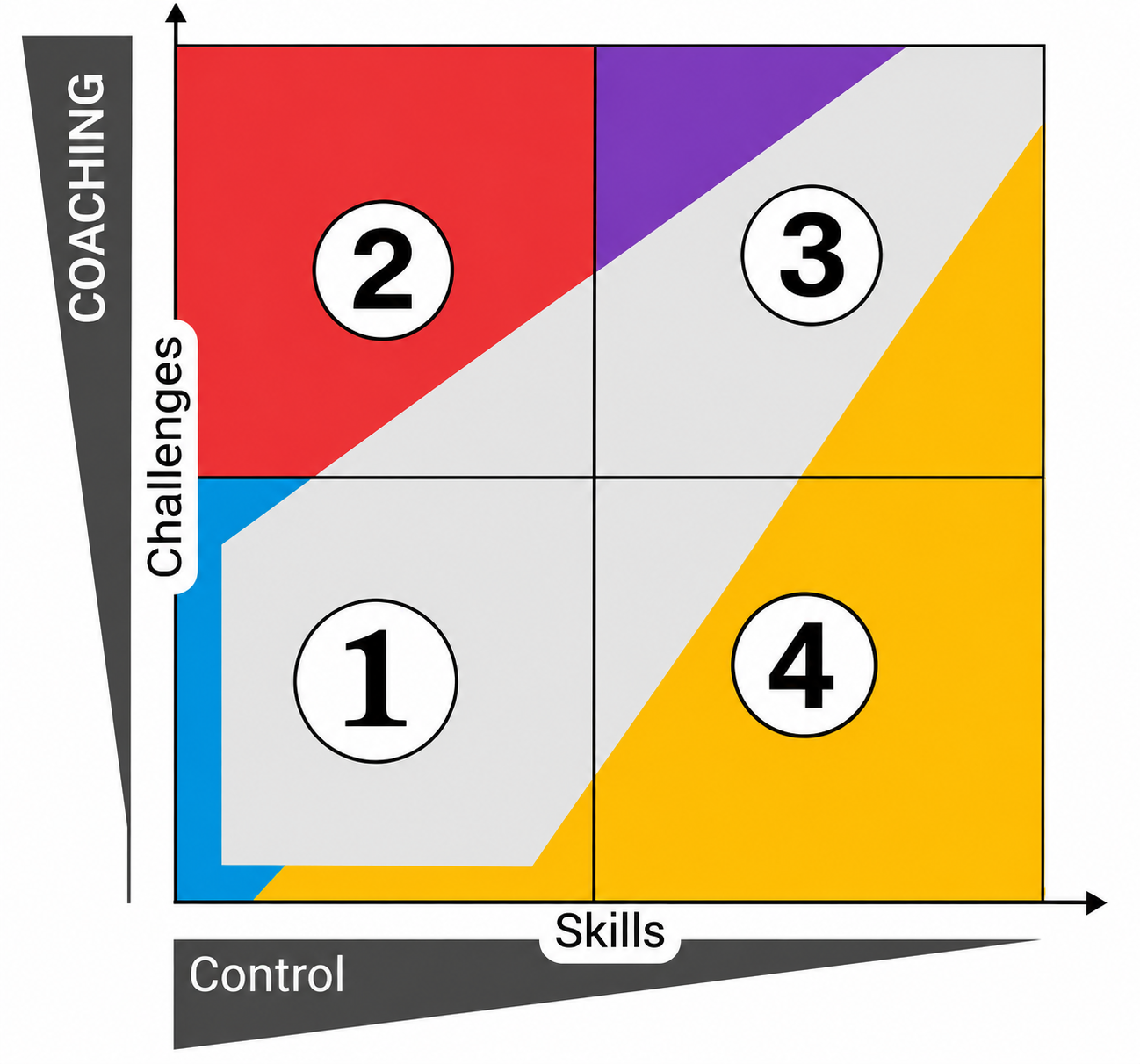
The need for attention, follow-up, recognition, and coaching increases in proportion to the level of real challenges employees face.
The need for control, structure, safeguards, and supervision decreasesin proportion to people’s competence and skills.
Here is your secrets as manager
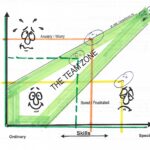
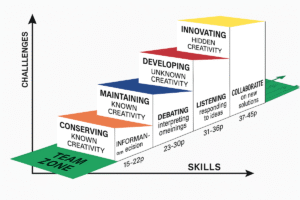
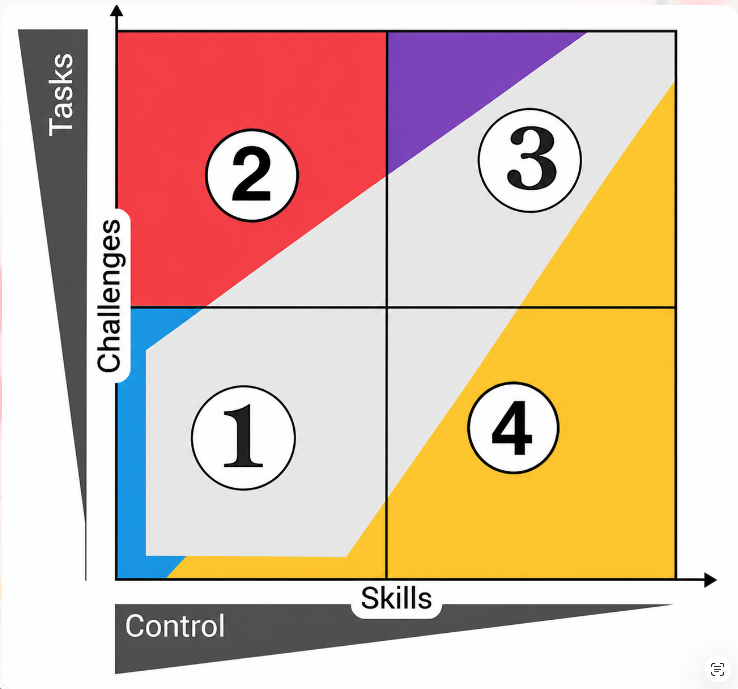
To illustrate this, we return to the Team Zone from Secrets 2,1, where individuals place themselves in a matrix with two axes: Challenges and Skills, with markings for their status quo. The smaller the zone becomes, the greater the challenges are, and the more specialised the skills required. To clarify our practical experience, we divide the square into four areas with our four colour language as shown in the figure, Each area represents a different situation that calls for a different leadership style, named: TSL
Imagine that you are a newly appointed leader. You are motivated, engaged, and ready for the task ahead. You have goals that inspire you, and a group of employees of different ages and backgrounds who each want to do their best. You begin with a team meeting where you introduce yourself following the example in Secret 1.3 – You share a few facts about who you are, what gives you energy, and finally something essential that your life cannot be without. Then you present the bigger picture — the tasks ahead and the solutions you hope to create together. You end the meeting by inviting everyone to a one-to-one conversation with you during the coming week, so you can gain the best possible overview of the team.
Dialogues / One Practical Initiative
To carry out such a series of conversations, preparation is important. This is where some of the tools in SGL can be highly useful. – We recommend starting by asking each person according to the colour language, a little about factual background. Then ask about hobbies, interests, or leisure activities. After that, introduce Secret 2.1 and the Flow Diagram, and use the illustration as the starting point for the personal conversation. – This creates a natural opening to discuss:
Current work tasks and responsibilities
Challenges and stress factors
Well-being and motivation
Opportunities for growth and development
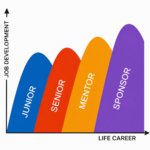
At the same time, you begin to see where the employee might place themselves in the TSL model. The next step is to explore the employee’s self-image and “job” age. Do they feel like a Junior, a Sponsor, or a Mentor in relation to their work tasks? This gives valuable insight into how they see themselves and where they may fit in the colour zones of the TSL model. Towards the end it maybe natural to ask about the working environment in the company and invite them to complete the Triple-T Test, for example by using the website: Secrets 8.3 Finally, after around 90 minutes, you thank them for the conversation and assure them that your door is always open whenever they wish to talk again.
Interpretation and Results
Conversations like these naturally require time, but they are worth the investment. Later, you will remember every minute and appreciate every word. Together, these conversations provide a small goldmine of insight about your employees. Used wisely, this knowledge can help make you an excellent leader. So let us now interpret the results.
JUNIOR Situation
In the lower-left area (Box 1), the team zone is broad and inclusive. According to age and experience is the challenges and required skills ordinary. The appropriate leadership style will in this situation normally require:
Low use of personal “yellow” attention and confirmation. High focus on “blue” training and quality assurance of tasks, responsibility, targets, and performance. Normal and OK: Triple-T-Test for box 1, is approximately 25-30 points
SENIOR Situation
In the upper-left area (Box 2), only a quarter of the box is within the team zone. The challenges are significant, while the expected skills are still ordinary, but above average. – The appropriate leadership style will require:
High investment in “red” and relations-oriented team attention and coaching to develop those who are uncertain, and to improve those who are “too comfortable” in the team zone. – Strong focus on “red” team and project management as a supplement to normal skill levels. Normal and OK: Triple-T-Test for box 2 is approximately 30-35 points.
MENTOR Situation
In the upper-right area (Box 3), the team zone is narrow and includes the center of the box. The challenges are great, and the expected skills are highly specialised. – The appropriate leadership style will require:
High investment in personal values and competence, At this level, people need “purple” visions and delegated tasks, but also “yellow” coaching to prevent burnout among highly self-driven specialists. Low need for direct “blue” control. At this level, people are motivated through independent work processes, high self-awareness, positive attention and direct feedback. Normal and OK: Triple-T-Test for box 3, is approximately 36-43 points.
“BURN OUT” Situation
In the lower-right area (Box 4), less than half the box is within the team zone. The challenges are small, while the expected skills are highly specialized. – Traditional leadership often shows:
Low investment in personal yellow attention, competence development, and coaching. Low focus on blue quality management and meaningful expectations. Normal and worrying: Triple-T-Test for box 4, is approximately 20-26 points
Our view: This situation calls for personal and “yellow” performance appraisal, change and renewal — such as restructuring, job rotation, or new sponsorship responsibilities — as soon as possible. We recomand: Coaching as a Leadership Tool
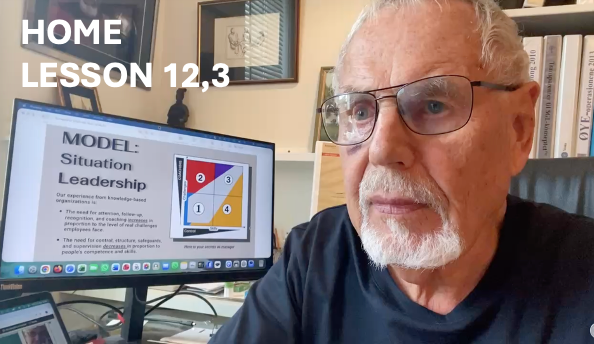
Home Lesson 12,3
BE DYNAMIC
Decide to conduct such a series of dialogues. Prepare well. Conduct at least one trial interview. Evaluate your own efforts: Satisfied / Not satisfied.
Note your experiences and request an assessment from SGL coach JP – Click Here