Secret: 10

I would like to begin with an experience.
Many years ago, I wrote a book about grief and grief reactions. This was long before the term crisis psychiatry was commonly used, but in essence we are talking about many of the same emotions and reactions. Over the years, this led me to give lectures at many seminars and courses on such topics. In recent years, I have also taught personnel connected to crisis and rescue services after major accidents.
These participants came from many professions: helicopter pilots, rescue workers, doctors in air ambulances, ambulance drivers, nurses, anesthesiologists, firefighters, police officers, priests, and funeral service staff. All were highly qualified in their practical tasks, but often unprepared for their own and others’ psychological reactions in situations of stress and catastrophe.
At the beginning of one such course, deep in the Ringebu mountains in Gudbrandsdalen, I got a provocative idea.
Instead of lecturing about crisis reactions — I would create them.

LESSON 10,2

Power Struggle

Characterized by: Criticism, subgroups, alliances and interest pacts, before the majority unites around the winner.

A LARGE GROUP EXPERIENCE

The seminar was scheduled to start at 2:00 p.m. A crisis psychiatrist and a Gestalt therapist, who were also lecturers, were part of the plan. However, we said nothing in advance. We only informed participants that the seminar would start exactly on time in the conference room.
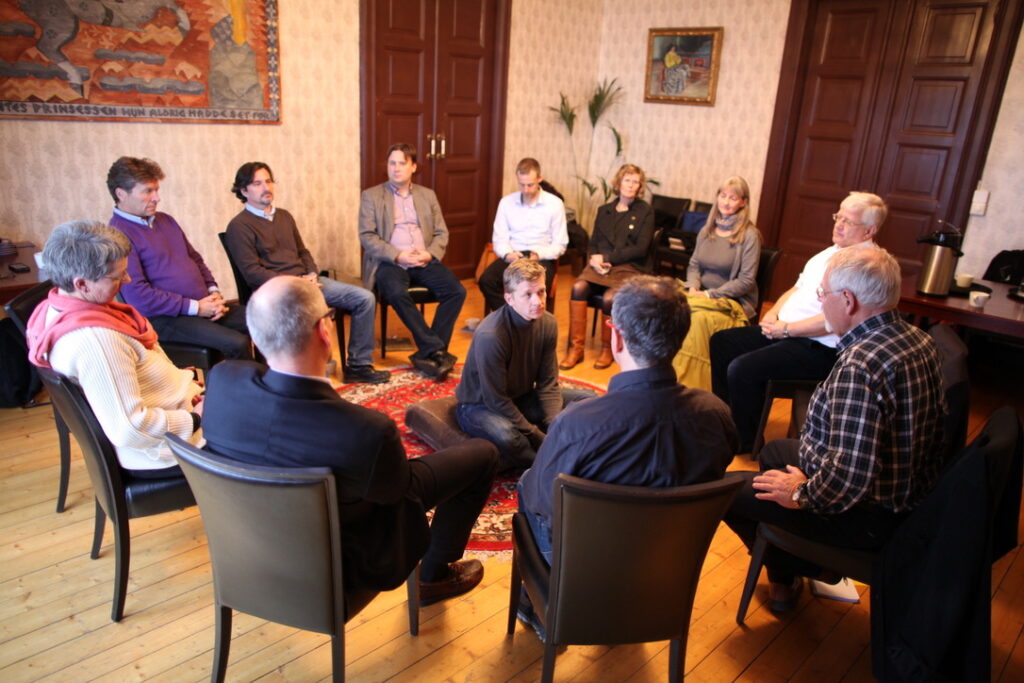
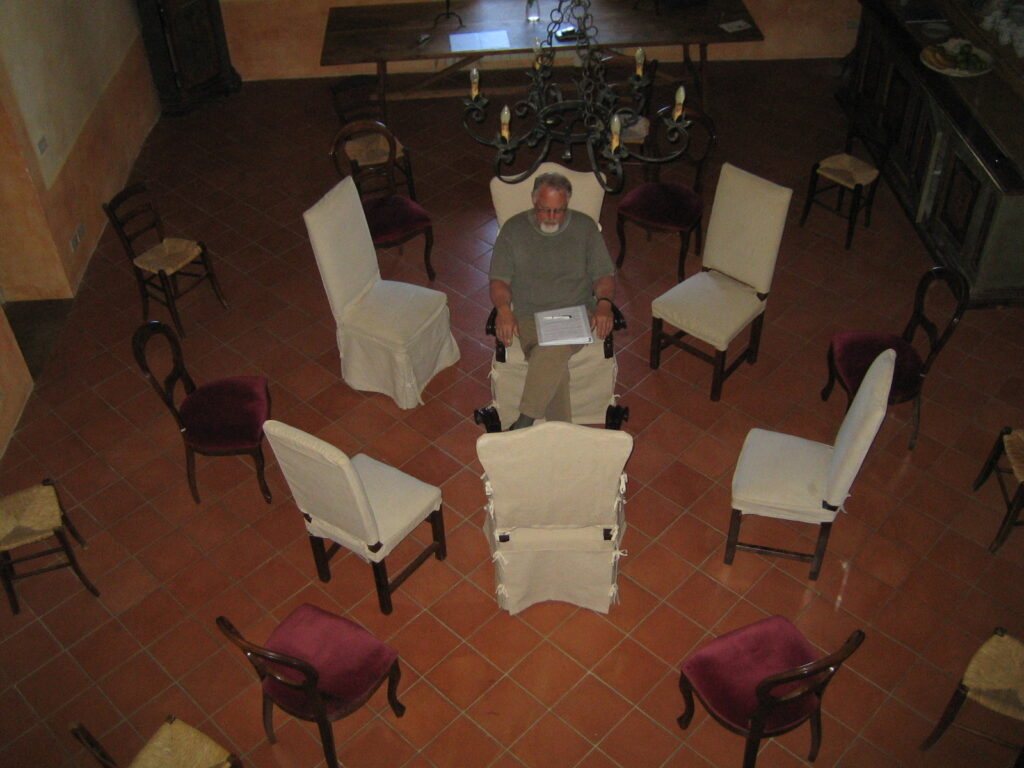
We opened the doors five minutes before the start. Most people were already waiting outside. Inside the room, we had placed 34 chairs — exactly one for each participant — arranged in three circles.
The inner circle had 8 chairs, the middle circle 11 chairs, and the outer circle 15 chairs.
I sat in the inner circle. The crisis psychiatrist sat in the middle, and the Gestalt therapist in the outer circle.
Most participants looked surprised when they entered. Some tried to joke. But everyone found a chair. At exactly 2:00 p.m., two chairs were still empty.

Demonstration of
positional power

Then we locked the door.

We continued to say nothing. Our defined positional power as seminar leaders was enough. After less than a minute, someone carefully tried the door. They realized it was locked. Restlessness began. No one answered.
After a few seconds, people started whispering to each other. Then several began to speak loudly, demanding that we open the door. We did nothing. More people joined the discussion. Many addressed us directly — mostly me, since I was perceived as the main lecturer.


I remained silent.

The tone became more direct and aggressive.
One participant said clearly that he would not pay for a course where the lecturer was obviously “on vacation.”

Expectations of initiative

Someone suggested opening the door. Then they looked at me, as if asking for permission. I stared straight ahead. The atmosphere became uncertain. One participant stood up decisively and walked toward the door.

I then said:
“It seems dangerous to accept that nothing is happening.”

The man turned sharply and sat down again. Silence followed. Finally, someone spoke and asked angrily how long we were expected to sit like this. I said nothing.
Others raised their voices. Everyone spoke into the air, or directly to me. There was no real communication between participants. It felt like everyone competing for attention. Someone suggested forming an alliance. Two people in the outer circle stood up to leave
 

The Gestalt therapist then said:
“It is clear that some want to escape both the situation and the responsibility.”

Attempted coup for leadership

 One participant took control immediately. He stood up and ordered the two who were leaving to sit down. They obeyed. He then moved to the front of the room and began a long explanation of what was happening and what the course leaders probably intended.
There was little response — but also no resistance.


I said: “The group is clearly so frustrated that it accepts any leadership.”

Making new needs visible

Almost immediately, the group dissolved into smaller conversations. People who had shared similar views sat together. Others, who had not spoken at all, began talking quietly with their neighbors. Many showed concern for one another and physical care.
For a long time, no one spoke in the plenary. We had been there for over an hour.
Then the course secretary — who had not been informed about the experiment — said:
“I suggest that the psychiatrist now takes over leadership. It is clear that the lecturer does not understand why he is here.”
She then said directly to the psychiatrist:
“Can you take over?”
The crisis psychiatrist said nothing and looked out into the room. Several participants engaged in the discussion, demanding a response from the course leader. None came.
The course secretary sat down in the chair next to me — the chair that had been empty all along.

I said:
“It is clear that the empty chair creates fantasies about a new leader.”

Awareness as value power

The silence became something people could feel. After a long while, the atmosphere changed. The silence felt safer. Someone looked at the clock and said it would soon be time for dinner. Another said it had been a strange experience. Others expressed curiosity and wanted to understand more.
A firefighter who had attended one of my courses earlier said:
“In these two hours, I have learned something about myself and my needs that I believe is important.”

At exactly 4:00 p.m., I stood up and left.
The Gestalt therapist stayed a little longer and said that we would review the exercise in detail during the evening session.