Why read it:

ChatGPT: “This is probably the most accessible introduction to Hagberg as a leadership writer. The book uses groups and communities as metaphors for human development.”

  • Focuses on relationships rather than quick techniques.

Highly recommended: Leaders, consultants and people working with human development.

  • Deals with responsibility, interaction, and maturity in groups.

Highly recommended:
If you see leadership
as a human practice.

  • Surprisingly timeless aligned with modern relational leadership.

Highly recommended:
If you see leadership
not just as management.

High tech

needs

High Touch

sets the agenda for a new workday and new role patterns in the relationship between leadership and employees.

What do we know – and what do we not know – because so few have done this before?


FACTS:

How you work? – and: What you miss?

Small groups - better than large departments

When employees are made more independent and turned into internal consultants and “process owners” within a value-creation chain of interconnected project organizations, several things happen at the same time:
  1. First, the work environment is fragmented, because time – both mental and physical –
    is split between many clients or assignments.
  2. Second, decision-making responsibility increases for each individual “process owner”, because many decisions must be made where the work is actually carried out, and most problems are solved where they arise.
  3. Third, project customers pay for competence delivery, not for competence development.

FEELING & EMTINESS

Red varm communication.

Blu cold communication

Most people experience their new role as “process owner” and “competence provider” as liberating and personally developing. It is exciting to be trusted. There is a sense of empowerment in being able to influence things, and it is challenging to be one’s own quality controller.
At the same time, this change reveals new organizational needs and new problems. It affects identity and emotions. At first, everything feels fine. Most people have enough experience, competence, and confidence to perform well in the new role. Over time, however, this becomes a temporary solution.
Customers demand more and more. There is less time for general competence development and for shared learning with colleagues in other projects. The original colleagues develop in different directions, and new people join whom you do not really get to know
Intranets and open workspaces replace the old information meetings, without necessarily creating anything new in their place. Gradually, the sense of belonging and the identity of the original professional community weaken.
The customer discovers that the quality profile is no longer predictable, even though the invoice still carries the same address and logo. A feeling of emptiness appears. The most independent individuals eventually begin to work as independent consultants.

Mentoring / The new leadership

When something goes out, something else must come in!
Old wisdom does not rust. When work and work are moved from a fixed address to a password in the cloud, something happens to us.
Relationships dry up. Small talks disappear. Creativity withers. – Communication becomes cold and technical. – AI and algorithms control most things. We have to learn:
Belonging and shared “ownership”
 of each other’s work tasks must become the new success factors!

A PRACTICAL APPROACH

The need for care and support will gradually increase as traditional line organizations weaken and new project-based structures take over. The response to this dilemma is coaching and supervision.
The project manager becomes the new day-to-day leader.
The base leader becomes the personnel manager, coach, and supervisor.
This requires new role understanding and new competencies from the base leader.
The success factor for a coach is having internal consultants in projects who are in demand, deliver high quality, and have strong professional competence.
This means that the base leader, as a consultant and coach, must develop the base group into a competence center that people want to belong to. The leader’s key asset is the ability to share experience, to see others, to support them, and to develop each internal consultant.

Looking ahead, we believe that large organizations will develop parallel competence centers or base organizations where internal consultants can apply for membership, similar to applying for a popular academic program at a university. External consulting firms may also specialize as base environments or supervision resources for groups of independent consultants and smaller consulting firms.

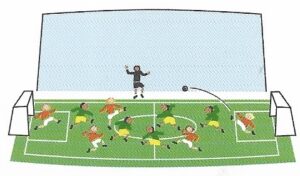
The following describes the new role of the base leader a football metaphor, the supervisor should be able to see and influence the game on the field—without being on the field themselves. – A good supervisor is someone who understands how. –The SGL supervisor’s success factors are the ability to:
  • listen
  • build networks and connect people
  • share knowledge and experience
  • provide support
  • develop and quality-assure internal consultants working in projects.

Home Lesson 9,1

WHAT`s your opinion? 

“The way forward leads backward. Today, cold technology and material wealth have made us strangers to one another.
So the way forward leads back to close human relationships, to emotions, community, and personal growth.
The way forward does not go through television and AI development. What we long for is not knowledge, but warmth. Not words, but life and trust.”

But more about this in the
NEXT LESSON /  Secret 9.2.

Inspire and Lead

Unleash Your Leadership Abilities Today

In the era of rapid changes, strong leadership stands out. Join us to explore new techniques that empower you to motivate and guide your team effectively. Lesson 6.1 is your gateway to enhancing creativity, boosting communication skills, and making a significant impact. Step up and lead with intention.