Secret: 11,3

The 8 Ethical Models

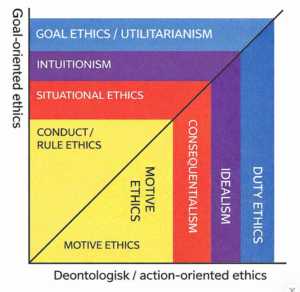
Start by slowly reading the descriptions of the 8 most well-known and used ethics models.
Recognize the words as you read.
Note two models that you feel sympathy for.
Choose one of them as your first choice, and the other as your secondary choice.
Look at the color
Does your first choice match your temperament role from Lesson 6.3? – YES / NO

Highlight the three-letter
code from Lesson 6,3

1. Consequentialist Ethics,
(Teleological Ethics)

Focus on the results and utility of actions. If the purpose is good, the action is good.
In practice, this may mean accepting a lesser evil to achieve a greater good — as the saying goes: “You can’t make an omelette without breaking eggs.” – Historically used as steering and utility ethics.
Key representatives: Augustine (*The City of God*) for purpose ethics, and Jeremy Bentham for utilitarianism.

SGL reflection: Does this create energy, progress, or clarity for you?

2. Duty-Based Ethics (Deontological Ethics)

Focus on moral action itself. The good life is defended by reason. The highest good is to uphold abstract moral rules and virtues: obedience, fidelity, humility, moderation, truthfulness, and mercy.
Such norms can be religious, cultural, or practical — like the categorical imperative: “Right the first time!” Historically used to defend human dignity and protect the established order.
Key representatives: Confucius (moral virtues) and Immanuel Kant (categorical imperative).

SGL reflection: What is your right thing to stand for?

3. Intentional Ethics (Ethics of Intention)

Focus on the intuitive certainty of the good that everyone can find within themselves.
Intuitionism appeals to individual responsibility and relativises ethical ideas to what is good for me is good for others, or the concrete communities with tradition and proven history (communitarianism).
Historically opens for diversity and change, but demands great tolerance and wisdom to avoid becoming authoritarian.
Key issues: You become aware of the intention behind your action.

SGL reflection:  What is driving you right now?

4. Idealism (Virtue and Moral Ideals)

Focus on the actions of wisdom and the Golden Rule — “Do unto others as you would have them do unto you.” The life we know is but shadows of the real world we can glimpse, as in a mirror. Only by seeking the true life, and the soul’s space for personal and spiritual growth, is energy freed for new life and new development (Quality of Being).
Historically opens for religious mysticism and universal wisdom about the vulnerable and irreplace-able as the very source of peace.
Key representatives: Lao Tzu, Plato, and Jesus

SGL reflection: What would be your most authentic and meaningful action?

5. Situational Sensitivity Ethics

Focus on responsible choices in the here-and-now of the moment. The existential zero point from which we can create the path as we walk, in relation to overarching goals and community values.
Appeals to the mature person who seeks the thrill of “leaping into 70,000 fathoms of depth” based on own faith and desire for continuous development.
Historically rooted in existentialism, which emphasises that human beings create their “being” through the choices of the moment: “Become what you are.” Key representative: Søren Kierkegaard.

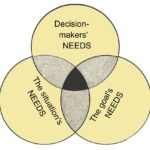
SGL reflection: What does the situation need right now?

6. Consequential Ethics (Pragmatic Consequence Focus)

Focus on the consequences of actions as morally significant. This expands the perspective from being merely a technique to becoming a practical life wisdom for sustainable development.
Opens for an ecological, holistic view that demands “best possible” quality because “everything is connected” as a living soul/holism. Historically promotes the good life for all. The question is: Good for whom? Interests easily collide.
Key representatives: Aristotle, and today the environmental green organisations.

SGL reflection: What must we reinforcing or changing over time?

7. Norm-Based Ethics (Rules and Behavior)

Focus on outward behaviour and goals that provide good models for quality control, order, conduct, and loyalty in relation to systems/bureaucracy/organisations and cultural communities — custom and practice, as expressed:
“I see what you say.” Strongly value-oriented and frees one from complicated ethical deliberations. The weakness is that the ethics can become “uniformed.”
Historically identity-creating and group-oriented — cf. the Ten Commandments. Promotes the idea of subordination and distinguishes sharply between task and person. Key representative: Frederick Taylor (scientific management).

SGL reflection: What are the explicit or implicit rules here?

8. Relational Ethics (Ethics of Care / Empathy)

Focus on what lies behind the outward action — the cause of the action as reflected in people’s lives. Attitude ethics strives for authenticity and wholeness.
Here, task and person are not separated: “We are what we think.” The decisive prerequisite for interaction is trust and direct care/coaching.
Historically points to spirituality and spiritual growth as the path to balance and harmony.
Key exemplars: Socrates, Buddha, Francis of Assisi, Mother Theresa and others.

SGL reflection: How does this affect you  – humanly?

Home Lesson 11,3

Repeat  and Find Your Roles

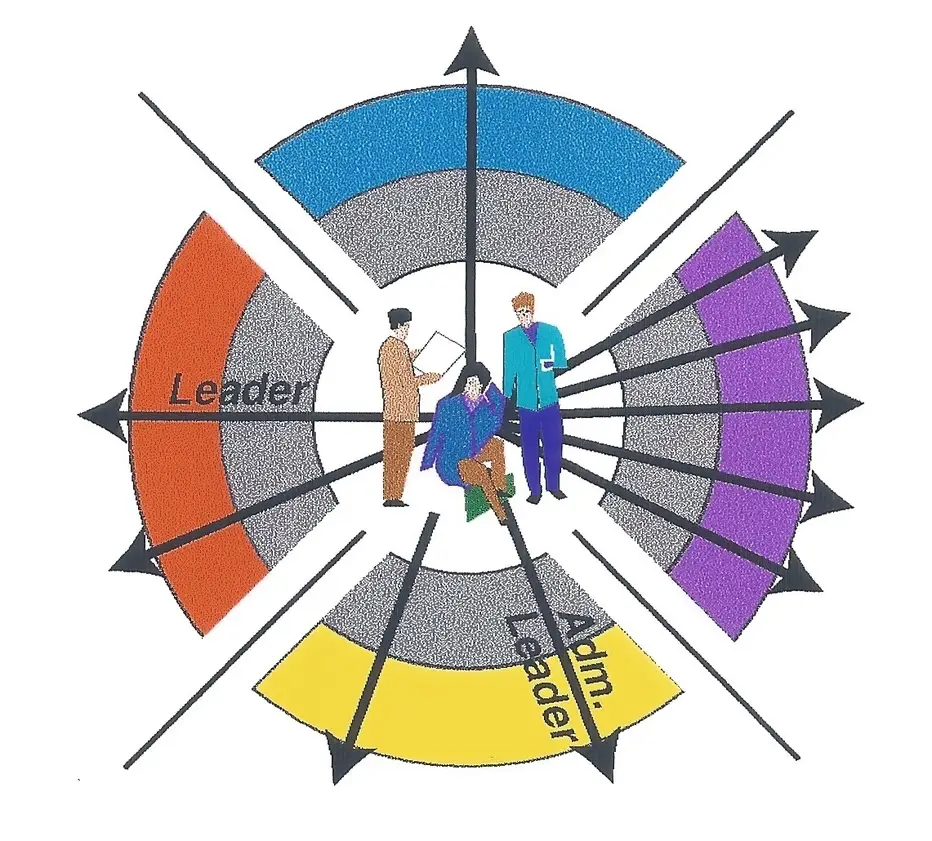
4,1: Note your color /Yellow/Blue/Red/Purple) on the dicision tree.
4,2: Identify your Strengt/Shaddow axes – either as TF (L) or SI (S)
4,3: Assess yourself as either a Warrior (W) or a Helper (H)
4,4: Note your elected ethical model.

NEXT LESSON / Secret: 12
SGL in practice. Use personal chemistry correctly and become a winning team