A Practical Approach
The intersection between quality development and ethical awareness becomes visible when the concept of “quality” no longer implies more of the same in terms of technical insight and technical improvements, but rather more of the wisdom of the soul—enabling the development of trust-based relationships and value creation in the here and now.
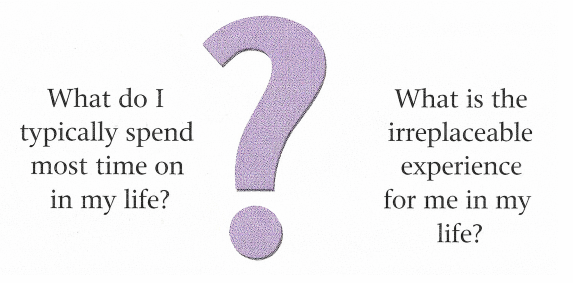
In a learning organisation, it is always experience that forms the foundation for the next step. In relation to the Situation, The Goals and The Decision-makers NEEDS, – this challenges us to ask:
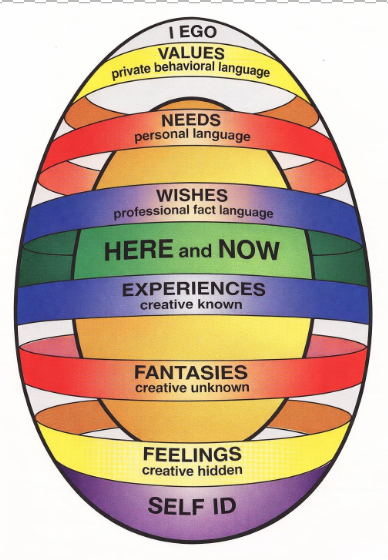
The egg symbol is one of the best illustrations in the SGL universe.
Imagine yourself placed in the green Here-and-Now-belt in the middle of the egg.
Above you sense your familiar horizon of desires and needs and sympathies.
Below you sense life’s experiences, hidden fantasies and deep feelings.
Everything is connected, and I will tell you why:
No one reaches higher than they are willing to go within themselves.
The secrets have always been here. The stories are told and retold in religious myths and mythologies all over the world. For us, it is important to open the narratives to understand the content of the content for our own time. The egg is such a symbol, with its mythological roots back to the origin of life and the polarity between our own EGO and our own original SELF. – In practice, this drama can play out in an event such as:
You find yourself in a situation where you need more space. The family has grown and you want two extra bedrooms.
The Wishes and possibilities are starting to become concrete.
Experiences is gathered about possible solutions both in terms of availability and money.
Needs is clear and in your
Fantasy you see what a new home could be like.
Values and wishes and needs are weighed against each other.
Feelings are challenged and put to the test with regard to unrest and uncertainty.In the end, gut feeling wins, and choices are made.
Ancient wisdom says: “Those who grow tall must grow deep,” otherwise one becomes like a tree without roots, or a house built on sand.
In the “egg symbol” — what we call the polarity model—we have sought to illustrate this timeless insight by placing the “soul space” between the heights of the Ego and the depth of the Self as a here-and-now polarity between:
Wishes/Experiences
Needs / Fantasies
Values / EmotionsIn practice, this means that if someone strives for change and ethical values without corresponding grounding, the effort will fail and lose credibility. The aim of ethics thus becomes to create a life with “soul space” in the polarity between the Ego’s everyday reality on one side and the Self’s deeper dimension on the other—where the soul room’s archetypal architecture reflects both temperament, gender, and personality type.
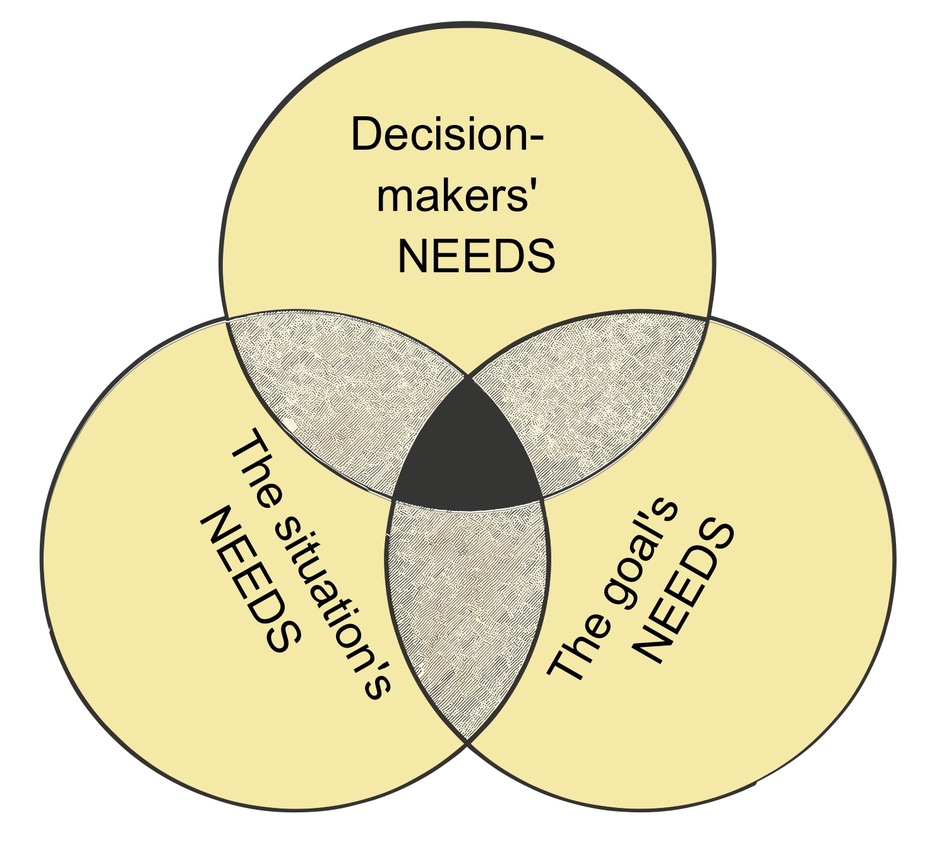
In this way, ethics is facilitated and challenged at the intersection between:
the decision-maker’s needs,
the situation’s needs, and
the goal’s needs (see figure on top).In leadership situations, this often means that the decision-maker’s needs become the only variable element among these factors.
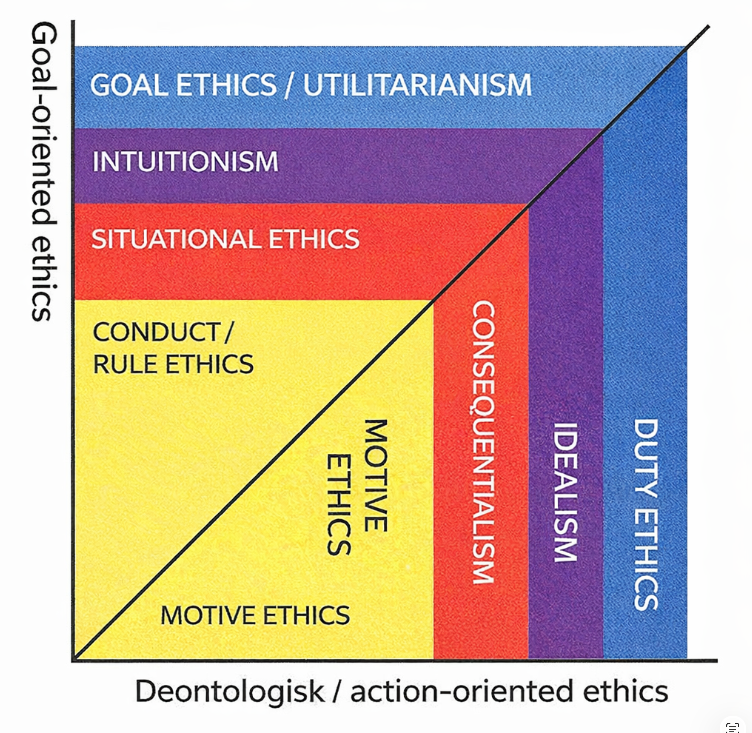
The “egg symbol,” through its understanding of polarity, highlights the so-called discourse ethics that can help us choose the right person or quality for the right team role, – or ethical model at the right time. A historical review of the most well-known 8 ethical models gives us an advantage by grouping them into two main traditions: