Secret: 11,1 / Values / Needs

Quality Mangement

LESSON 11,1

QUALITY and ETHICS – Here and Now

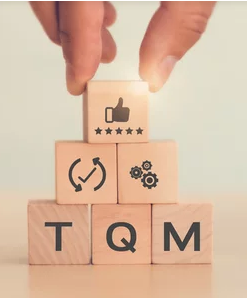
As we see it, there is a profound connection between “the purpose of quality work” (TQM), the Core Values of our life (The polarity model) and the purpose of Ethics and models, — which give the best possible result. At their core, they are all about one thing: realising a view of humanity where real needs are recognised and fulfilled.
Ethics is often described as something abstract, even vague. Yet in reality, it is anything but. Every single day, through our choices, attitudes, and actions, we leave ethical footprints. Whether we settle for “good enough,” strive to get it “right the first time,” or push toward “the best possible,” these choices define not only what we do—but who we become.
Ethics is not neutral. It shapes behavior, guides decisions, and reveals what we truly value—both when we act and when we choose not to act. But not all ethics is equal. Different situations demand different depths of responsibility. This confronts us with a fundamental freedom—and a fundamental challenge: the freedom to choose between better and poorer solutions, guided by our own standards and by the shared values we are willing to stand for.
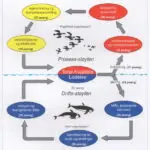
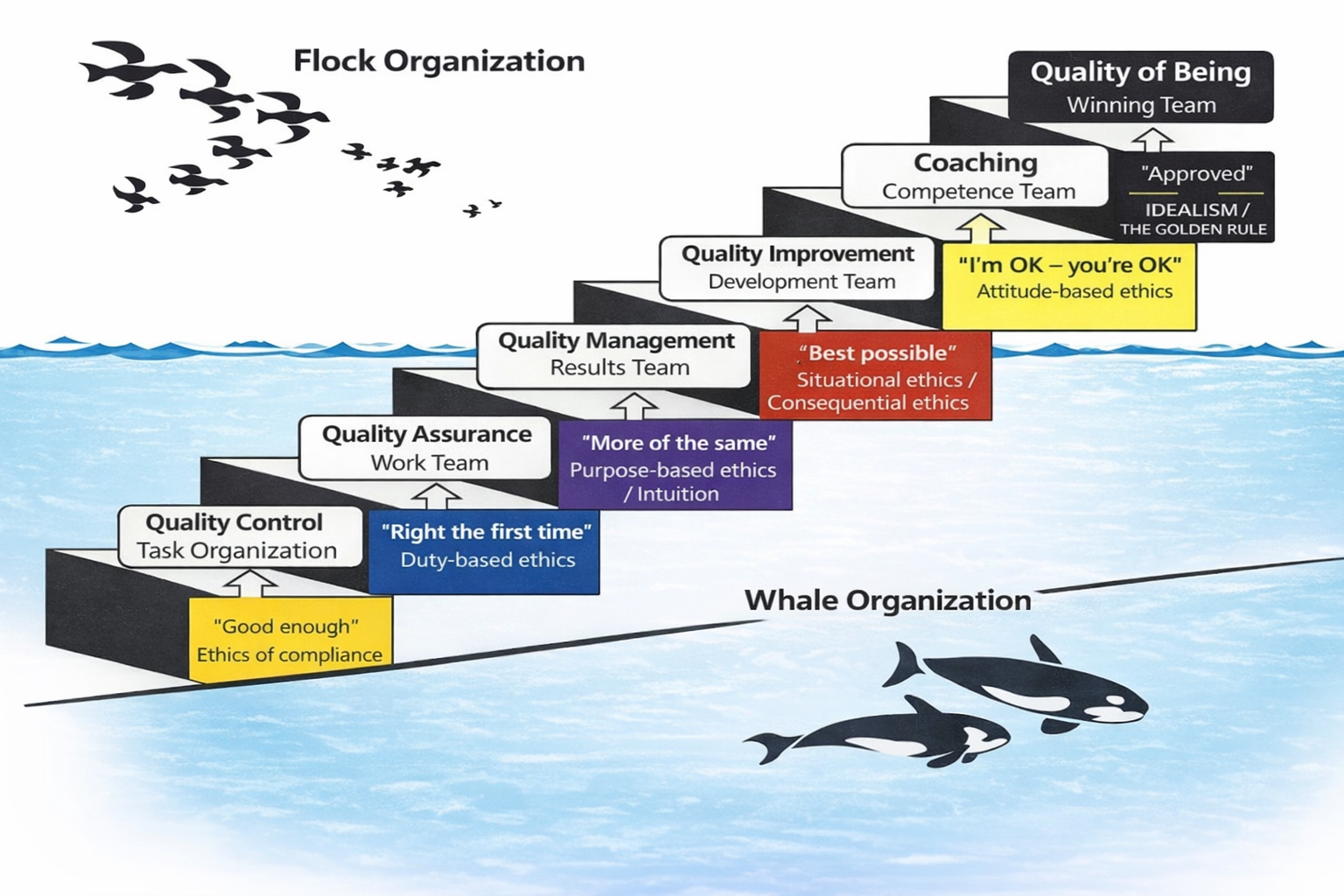
If we truly want to achieve meaningful results, these values cannot remain ideas. They must be lived. Simply put, the relationship between quality and ethics can be understood like this sgl-illustration called: The staircase of TQM:
Kvalitetstrappen
  • The Quality Ladder must be understood in light of the figure-eight loop described in Secret 3. – The colors carry the same meaning, but here double-loop learning is translated into a stepwise progression across six levels.
  • Each step represents a distinct level of quality. The next level can never be reached unless all requirements at the underlying level have been fulfilled. The terminology used will be familiar from Total Quality Management (TQM).
  • As in the figure-eight loop, the Quality Ladder distinguishes between two different “universes”: one below and one above the waterline.
  • Below the surface, work is governed by planned development and controllable procedures. Above the surface, it is driven by continuous improvement, dynamic work processes, and emerging goals.
Below the Waterline
the first level begins with:
Quality Control / Task Organization
Its objective is to deliver “good enough products,” based on a rule-oriented, value-driven Ethics of compliance. – This is followed by:
Quality Assurance / Work Team
Guided by the principle “right the first time,” rooted in a detail-oriented Duty-based ethics.
Then comes the final rule-governed level:
Quality Management / Result Teams
With the ambition “more of the same,” grounded in a results-oriented Purpose-based ethics.

Above the Waterline
we encounter a qualitative shift!
Or a small quantum leap in leadership philosophy. Leadership moves from being controlled by a single authority—a captain, director, or general—to a distributed model, where responsibility is shared across multiple leadership processes. These must be coordinated, like a flock of birds, to move in the same direction.This transformation begins with:
Quality Improvement / Development Team
Driven by the ambition “the best possible,” and guided by a perceptive, experience-based Situational ethics.
This, in turn, opens for more delegated and dynamic processes, requiring:
Quality Coaching / Competence Team
With the message “you are OK,” grounded in an attitude-based ethics that reminds us:“You become what you think.” – Finally, this leads to a culture built on deep trust and mutual respect, expressed through:
Quality of Being / Winning Team
With the affirmation “you are accepted as you are,” rooted in an idealistic ethics inspired by the Golden Rule: “Do unto others as you would have them do unto you.”

Home Lesson 11,1

Find Your Quality Values

Quality management and values ​​are closely linked. – Therefore, explore the quality ladder step by step, and note which level your work tasks require and which level you actually are at. – Does the answer match reality? – True / False??

But more about core values in the
NEXT LESSON /  Secret 11.2.