
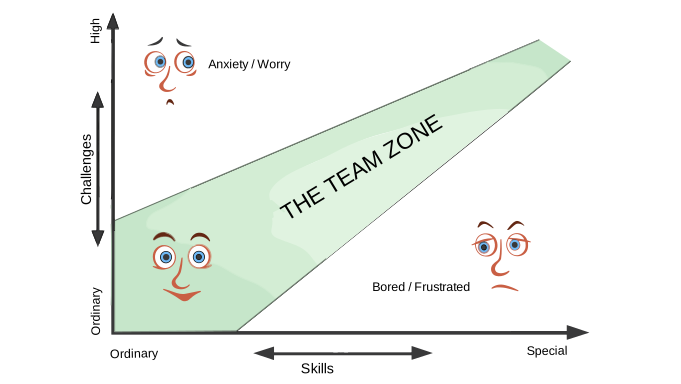
The TeamZone is a simple model that you can use for yourself, or as an opening for an employee interview. With a pencil, mark your subjective and perceived position on the vertical axis, in relation to the challenges you are facing. Then you let the pencil go along the horizontal axis until you mark the point of your own perceived competence. Finally, you extend your vertical and horizontal points until they meet. There you put a cross, and start analysing the answer.
Crisis and growth
The Americans have an expression called “A letter from disaster”. It can be compared a little with the Norwegian proverbs “A small straw can overturn a big load”, or “it was the drop that made it all overflow”. The message is, however, the same. Life is fragile and can quickly change from prosperity to crisis. The same happens when you are either forced or thrown out of your comfort zone, or “flow”, as the illustration in the SGL concept shows.
By “crisis” we thus understand a situation where you move from a familiar situation to another. The whole thing can be compared to crossing the open sea, or a raging river, or a motorway, from one side to the other — and being forced out of your own comfort zone and flow. In all cases, crossing poses a risk that can change your life forever. The hallmark of the crisis is therefore the actual crossing: the journey, the flight, from a known situation to an unknown one.
The crisis — or “change”, if you will — makes us vulnerable, and opens us up to stress and to fear of what might happen. It may be an unexpected dismissal from work, an unexpected tax claim, a birth, a divorce, a cancer diagnosis, disability, a pension, or a planned move or emigration from one place to another. In all cases the situation brings about a change, with corresponding “grief reactions” over losing something familiar in order to have to start something else. Everyone experiences it, but few talk about it.
Even small changes can lead you into a “crisis” that both you and the people around you faced completely unprepared. Then it is important to recognise the “characteristics of the crisis”, and to walk the path — either alone, or with someone you trust. The conclusion: we are vulnerable. Let us take care of each other when we end up outside “flow”, as described in my still current Norwegian book Død – uten Brodd / Death – without sting, from 1978.
Read on in SGL